


Remuneration report
Letter from the Chair of the remuneration committee
Dear shareholder,
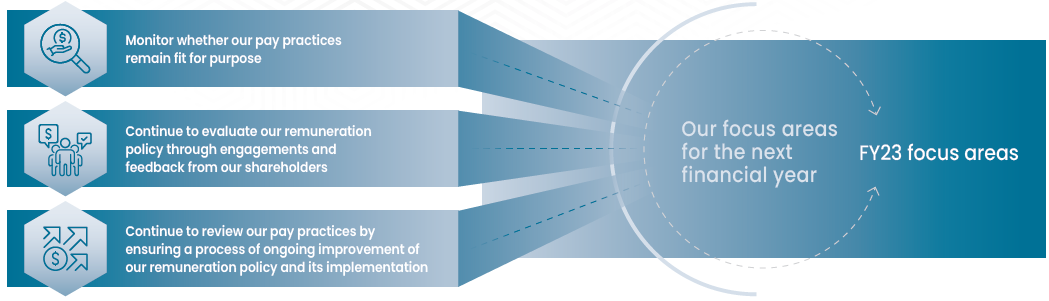
On behalf of the remuneration committee, I am pleased to present our FY22 remuneration report for the MultiChoice Group. I would like to thank my fellow remuneration committee members, Adv Kgomotoso Moroka and James du Preez for their valuable contributions during my first year as remuneration committee chair.
I would also like to thank our investors for the constructive engagements prior to the 2022 AGM and for their input provided. The remuneration committee conducted an extensive review of our Remuneration Policy which included numerous investor meetings, an extended benchmarking analysis and additional consultation with our advisors which aided in continuing to improve in pursuit of best practice.
Feedback from investors was combined under a number of key issues, which is where we focused our efforts this year. These are listed below together with the steps taken to address the concerns:
| Issue | Remuneration committee response | |
| No retrospective disclosure on STI and LTI targets | We have included retrospective disclosure on performance relative to STI and LTI targets (below). | |
| LTI targets not linked to external metrics | LTI targets based on internal budgets have been replaced with targets linked to objective/external performance metrics (refer to the below). | |
| No disclosure of forward-looking performance targets |
LTI metrics linked to objective/external benchmarks will allow shareholders to determine forward-looking targets (refer to the below). However, we will not be introducing disclosures of forward-looking performance targets for our STIs due to the highly sensitive/competitive nature of these targets for key executives. | |
| Lack of ESG targets | ESG performance hurdles, based on a blend of external agency ratings and company specific measures, have been included as part of LTI metrics (refer to the below). | |
| Limited disclosure of the PPS share scheme | Additional disclosure on the PPS scheme has been included (refer to Remuneration report ). |
Further detail on these enhancements are disclosed below. Following the 2022 AGM, we look forward to once again engaging with you, our shareholders, on our remuneration policy and voting outcomes.
Regards
Jim Volkwyn

The background
statement
The background statement provides context around performance and how this influenced our remuneration decisions.

The remuneration
policy
The remuneration policy is a forward-looking section that provides an overview of our remuneration philosophy and policy.

The implementation
report
The implementation report is a backward-looking section that discloses the remuneration and performance outcomes of the executive directors based on the FY21 remuneration policy.
The background statement
The global video entertainment industry continues to experience disruptive shifts in technology, consumer preferences and competitive offerings. As these trends increasingly impact our markets, MultiChoice is evolving from a traditional pay-TV business to a broader consumer services platform that offers a growing ecosystem of entertainment options, and scalable, tech-based consumer products and services that address household needs. We are developing our platform and pursuing new growth opportunities through a combination of organic investment, strategic partnerships and targeted investments.
We have continued to aggressively manage costs in a challenging operating environment as most economies exit the COVID-19 pandemic but are faced with pre-existing challenges and disruptions from global macro-economic and geopolitical developments. We strive to make a positive impact in the communities and countries where we operate while, at the same time, focus on the ongoing development of all our employees.
It is critical that our remuneration policy incentivises our executives to pursue sustainable long-term value creation by incorporating the above factors while aligning with shareholder requirements and best practice.
Shareholder voting and engagement
The table below reflects the non-binding advisory votes received in support of our remuneration report over the past two years:
| AGM resolutions | FY21 % | FY20 % |
| Remuneration policy | 35.8 | 65.9 |
|---|---|---|
| Implementation report | 35.5 | 67.6 |
We fell well short of the 75% approval threshold and initiated an engagement process that included meetings (detailed below) and a dedicated email address for shareholders to provide feedback, suggestions and comments.
| Investor | Type and date of engagement |
| Mergence Investment Management | Meeting on 9 March 2022 |
| Aeon Investment Management | Meeting on 9 March 2022 |
| Sanlam Investment Management | Meeting on 9 March 2022 |
| Stanlib Asset Management | Meeting on 9 March 2022 |
| Visio Capital Management | Meeting on 9 March 2022 |
| Old Mutual Investment Group | Meeting on 10 March 2022 |
| Abax Investments | Meeting on 10 March 2022 |
| Ninety-One | Meeting on 10 March 2022 |
| Allan Gray | Meeting on 10 March 2022 |
| M&G Investments | Meeting on 11 March 2022 |
| Argon Asset Management | Meeting on 11 March 2022 |
| Public Investment Corporation | Meeting on 16 March 2022 |
| Coronation Fund Managers | Meeting on 17 March 2022 |
| Groupe Canal+ S.A. | Meeting on 28 March 2022 |
LTI performance measure changes
We have moved away from LTI performance targets linked to internal budgets and implemented objectives linked to objective and/or external measures for PSU awards. These will be effective from FY23 awards going forward. All previous PSU awards will be grandfathered based on the performance targets set on the date of award:
| FY22 LTI performance measures based on budgets | Weight (%) |
| Core HEPS growth | 25 |
| Free cash flow | 50 |
| Return on capital employed | 25 |
| LTI FY23 performance measures | Weight (%) | Comments | |
| Core HEPS growth | 40 | Move from delivery against budget to year-on-year growth | |
| Free cash flow conversion ratio | 15 | Move from absolute free cash flow generated per budget to conversion of reported Trading Profit | |
| Nigeria cash extraction | 10 | An important focus area for management | |
| Total shareholder return (TSR) | 25 | Added as new targets to align with shareholder interests | |
| ESG | 10 |
Further detail on each measure is disclosed below:
| Weight (%) | Threshold | Target | Stretch | Details | |||||||
| Core HEPS growth | 40 | Weighted Average Cost of Capital - Dividend Yield | Weighted Average Cost of Capital - Dividend Yield + 2% | Weighted Average Cost of Capital - Dividend Yield + 4% |
|
||||||
| FCF (pre-tax) conversion ratio | 15 | 95% | 98% | 102% |
|
||||||
| Nigeria cash extraction | 10 | 70% | 75% | 80% |
|
||||||
| Total shareholder return (TSR) | 25 | Median of comparator group | Average of Median and Upper Quartile of comparator group | Upper Quartile of comparator group |
|
||||||
| ESG | 10 | Based on a blend of external agency ratings and company specific measures (detailed below) | |||||||||

Phantom performance share (PPS) plan
The world is changing rapidly, and the rate of change is accelerating as various technologies grow and intersect. Given the importance of successful new investments in driving sustainable long-term growth and to facilitate a fundamental shift in our approach, the group has implemented a PPS plan to complement our performance share unit (PSU) LTI plan. This plan, which is linked to aggressive performance hurdles for new strategic investments, replaced the 25% RSUs that previously did not have any performance conditions attached to them.
The PPS plan provides select executives involved in driving strategy, with exposure to the growth of a portfolio of strategic investments, which are intended to have a transformational impact on the nature and value of the group over time. Participation in the scheme is limited to executives who play a crucial role in the closing and oversight of the relevant investments. Awards vest over a period of five years, in two equal tranches in years four and five. The PPS allocation is capped at a maximum of 25% of the individual's annual share allocation, with the remainder of the allocation being PSUs. This weighting ensures executives are focused on both the core business and on driving new growth opportunities.
A key feature of the PPS plan is the particularly stretching performance conditions that are applied. There is no vesting if portfolio returns are at or below 12.5% per annum (our approximate group weighted average cost of capital), and full vesting only occurs at superior returns of 25% per annum (double our approximate group weighted average cost of capital).
The portfolio returns for each award and the unit value of each award will be based on the 'like for like' measurement of the portfolio of assets in place on the award date when measured, four or five years later. For example, if assets A, B and C are in place on the 2022 PSS award date, then the aggregate opening and closing values of these assets, and any dividends and distributions received from these assets will be considered when measuring the portfolio return from the award date in 2022, until the measurement date in 2026 and 2027. If asset D is acquired after the 2022 award, but before the 2023 award, then the aggregate value and dividends from assets A, B, C and D will be used for the determination of the value and performance of the 2023 award units.
The returns for the PPS scheme are measured on the growth in portfolio value using external valuation inputs where possible. The valuations are conducted annually and are based on the following methods (in order of priority):
- The latest arm's length share transaction, which has occurred not longer than 24 months preceding the measurement date, for a minimum of 5% of the asset valuation.
- 100% current year core headline earnings x earnings multiple plus net cash/less net debt. The earnings metric and multiple are approved by the committee when a relevant portfolio asset is added.
- An independent third-party valuation, where no clear transaction value exists, for example in a start-up scenario. This valuation will only be valid for three years, after which methods 1 and 2 would become applicable.
The valuations are performed by an independent third-party (currently Deloitte), while the scheme outputs are also verified by our external auditors.
STI Performance measure changes
Core headline earnings will be replaced by Core headline earnings per share in the company multiplier to better align with the LTI measure and because it reflects a better alignment with shareholders who are exposed to earnings growth on a per share basis i.e. incorporating changes in the number of shares in issue.
Independent remuneration adviser
Bowman Gilfillan are appointed as independent adviser to the remuneration committee, and we are satisfied that their advice is objective and independent.
The remuneration committee met four times before the financial year-end and is satisfied that it achieved its objectives and complied with its statutory duties.
A key focus of this year’s activity was to address shareholder concerns around the remuneration policy and the implementation thereof. In addition, the following key decisions were made:
- Approved the change to the STI company multiplier metric (core headline earnings per share)
- Approved the executive committee goals and targets for FY23
- Approved the executive committee FY21 bonus, FY22 salary increases and share awards
- Approved the non-executive director fees
- Approved the salary increases, bonuses and share awards for all employees
- Approved the new PSU measures and targets
- Approved the Irdeto RSU plan awards
Non-binding advisory vote on remuneration policy and implementation report
The remuneration policy and implementation report, as set out in Parts 2 and 3 of this remuneration report, will be tabled for separate non-binding advisory votes at the AGM on 25 August 2022. If 25% or more of the voting rights exercised vote against either the remuneration policy or implementation report or both, the board will take steps, in good faith and with best reasonable effort, to do the following as a minimum:
- Implement an engagement process to ascertain the reasons for the dissenting votes
- Aim to address legitimate and reasonable objections and concerns raised appropriately, which may include amending the remuneration policy, or clarifying or adjusting remuneration governance and/or processes
- Report on the above in next year's remuneration report
The remuneration policy
Remuneration philosophy
Our remuneration philosophy is informed by the group's strategy and capital allocation process and enables us to achieve our business objectives. Our commitment to pay for performance aligns with the principle of creating long-term value for our shareholders - it drives our remuneration activities and supports the ownership mentality and spirit of entrepreneurship in our teams around the world. As far as possible, our pay structure is similar across the business and it exceeds the minimum legal requirements in all the jurisdictions in which we operate. We endeavour at all times to balance the need to compete globally for the best talent with the need to pay fairly and responsibly.
When making executive pay decisions, we consider the individual's performance, the business's performance, the complexity of executives' responsibilities, as well as the growth trajectory and lifecycle of the business unit for which he/she is responsible. Our STIs are aimed at rewarding employees for overperformance in a specific year and are typically capped at a percentage of an employee's salary. Our approach to LTIs strives to ensure executives are invested in driving the business' sustainable performance and shareholder value creation over the long term.
Talent and fairness
We aim to be the preferred employer for candidates and current employees in the entertainment and digital platform security sectors and to be recognised as a leading employer in the markets where we operate.
We focus on recruiting experienced talent for critical areas of product development and service delivery, such as technology, data, digital and content. We also provide opportunities for new, young talent to learn and develop. These, combined with our other internal disciplines, are important to scale our business and deliver our strategic and operational imperatives.
We strive to recruit and retain the best calibre of executive talent to lead the organisation and create value for our stakeholders. Balancing the levels of executive remuneration with the demand to remain competitive in attracting global talent in the video entertainment industry has become challenging. In particular, we are seeing increasing competition for talent from our OTT competitors across all our markets.
Our investments and collaboration with leading educational institutions, industry bodies, partners and subject matter experts enable us to recruit and build young talent to drive our business forward. We grow local talent through the MultiChoice Talent Factory which seeds, incubates and nurtures African storytellers. We further develop deep technical TV, film, technology, engineering and data science expertise in partnership with prestigious global institutions like the New York Film Academy, Duke University, Henley Business School and leading local institutions in each country such as the University of Pretoria and Wits in South Africa. The Chairman's Top Leaders Programme partners with Harvard Business School and aims to build executive capability and capacity.
We continuously monitor the level of fair and responsible pay for all our employees and we are aware of pending legislation on required pay gap disclosures. Our minimum salary in South Africa is more than three times the current minimum wage requirements set by the government. We are proud of the suite of benefits offered to our employees (detailed below).
Remuneration structure
The policy table sets out the group's remuneration structure which also applies to the executive directors and key senior executives. To provide a more comprehensive view, policies applicable either to different levels of employee and/or different geographic areas are included where appropriate.

 Guaranteed pay and Short-term incentives
Benchmarking
We strive to be consistent, offering remuneration packages that help attract and retain the best talent in our market. We consider market practices, business requirements and the calibre of the individual in our recruitment processes.
We benchmark our remuneration using the Old Mutual Remchannel Survey in South Africa and the Mercer Total Remuneration Surveys in the Rest of Africa. For executives, who we sometimes recruit globally, we use the LMO Executive Survey and the Willis Towers Watson Executive Survey. In addition, we use bespoke benchmarking using input from our remuneration adviser when appropriate.
We target our guaranteed salary at the median of the market with exceptions based on performance and critical skills.
For the executive committee, we benchmark remuneration against the same peer group of companies used for the TSR measure, i.e. Vodacom, MTN, Telkom, Shoprite, Clicks, Bidvest, Discovery, Mr Price, Foschini. Our approach to performance incentives is to award STIs below the average of our peer group and a higher LTI component as we believe this will ensure alignment to shareholder interests. This approach ensures that our blended outcome for our executive committee on both STI and LTI aligns with the market.
Malus and clawback
We believe inappropriate conduct should not be rewarded. To protect stakeholders against inappropriate conduct by executives, malus and clawback provisions apply to all variable pay (STI and LTI) for the MultiChoice executive committee. These provisions enable us to recover variable remuneration awards made, based on the occurrence of a trigger event caused by the participant, which led to loss or damage incurred by the group.
Trigger events include, but are not limited to:
- The group or any subsidiary's financial statements having been materially restated
- The executive having deliberately misled the group or any subsidiary, the market and/or the group's shareholders regarding the financial performance or position of the group
- The executive's actions brought the group, subsidiary and/or the executive's business unit into significant disrepute
- The executive's actions amounted to gross misconduct or a material error
- The subsidiary or the business unit in which the executive works having suffered a material failure of risk management
- Any other matter which, in the reasonable opinion of the remuneration committee, is required to be taken into account to comply with prevailing legal and/or regulatory requirements
Malus will be applied prior to the vesting and/or payment of any STI or LTI. Clawback will be applicable for up to three years after the vesting and/or payment of any STI or LTI.
Service contracts
Executives' service contracts comply with terms and conditions of employment in the jurisdiction where they are employed. Executives' contracts do not contain guaranteed payments on termination. Details of the date of appointment and relevant notice period for executive directors and prescribed officers are set out in the table below:
| CP Mawela | TN Jacobs | |
| Date of appointment in the current role | 1/11/2018 | 1/11/2018 |
| Notice period | 6 months | 6 months |
| Restraint period | 12 months | 6 months |
Recruitment policy
On the appointment of a new executive, his/her package will typically be in line with the principles as outlined (refer to Remuneration report ). To facilitate recruitment, it may be necessary to compensate for remuneration forfeited on exiting the previous employer. This will be considered on a case-by-case basis and may comprise cash or shares.

Termination policy
Payments in lieu of notice may be made to executives for the unexpired portion of the notice period. On cessation, there is no automatic entitlement to an annual performance-related incentive (bonus). However, the committee retains the discretion to award a bonus to a leaver during the financial year considering the circumstances of his/her departure.
Termination provisions related to LTI plans are as follows:
| LTI termination provisions | ||
| Death, ill health, disability or other event approved at the board's discretion |
|
|
| Redundancy or termination as a result of a business disposal or change of control/jurisdictional issue or retirement |
|
|
| For other causes |
|
Minimum shareholding required (MSR)
To encourage individual shareholding in the group and to align with shareholders' interests, the following minimum shareholding is required for all members of the executive committee. To allow time for the executives to build up a shareholding in the MultiChoice Group, these MSR requirements are to be met by July 2024 for current executives. The timeframe for new executive committee members to reach the MSR is five years from the date of appointment.
| MSR as % of salary | |
| CEO | 300% |
| CFO | 200% |
| Executive committee | 100% |
Remuneration policy applicable to non-executive directors
Terms of appointment
The board has clear procedures for the appointment and orientation of directors, and annual self-evaluations are completed by the board and its committees. The nomination committee periodically assesses the skills and diversity represented on the board and determines whether these meet the group's needs. Directors are invited to give their input in identifying potential candidates. Members of the nominations committee propose suitable candidates for consideration by the board and a fit-and-proper evaluation is performed for each candidate before they are considered/appointed.
Retirement and re-election of non-executive directors
All non-executive directors are subject to retirement and re-election by shareholders every three years. Additionally, non-executive directors are subject to election by shareholders at the first suitable opportunity for interim appointments. The names of non-executive directors submitted for election or re-election are accompanied by brief biographical details to enable shareholders to make an informed decision on their election. The reappointment of non-executive directors is not automatic.
Setting non-executive directors' fees
The fee structure for non-executive directors was designed to ensure we attract, retain and appropriately compensate a diverse and experienced board of non-executive directors. Non-executive directors receive an annual fee as opposed to a fee per meeting, which recognises their ongoing responsibility to ensure effective governance of the group. Remuneration is reviewed annually and is not linked to the group's share price or performance. Non-executive directors do not qualify for share allocations under the group's incentive schemes. A comprehensive benchmarking exercise is performed using PwC's non-executive director surveys and this is tabled annually for consideration by the remuneration committee and the board to determine what the proposed directors and committees' fees should be.
Directors on the MultiChoice Group board have cross-membership on the South African major subsidiary boards: MultiChoice South Africa Holdings Proprietary Limited and MultiChoice South Africa Proprietary Limited. Non-executive directors with such cross-memberships receive a single fee at a MultiChoice Group level.
Non-binding advisory vote on remuneration policy
The remuneration policy, as set out in Part 2, will be subject to a non-binding advisory vote by shareholders at the AGM on 25 August 2022.
The implementation report
This section explains how the remuneration policy was implemented in the reporting year and reflects the resulting payments each executive director received (backward looking). All decisions in relation to executive remuneration were made in line with our remuneration policy for this financial year.
FY22 Salary adjustments
The committee approved a 3.8% salary increase in FY22 for all employees in South Africa. Increases in other countries vary based on economic conditions, inflation, market trends and internal comparability.
FY22 STI outcomes
Financial/group goals
In the following tables we outline the actual STI outcomes for each financial performance measure relative to the target set at the beginning of the financial year:
| FY22 STI | Weight (%) |
Threshold (80%) |
Target (100%) |
Stretch (120%) |
On-target outcome (%) |
% of target achieved |
FY22 outcome (%) |
| Revenue | 25 | 2% below target | On-target | 2% above target | 25 | 102%(1) | 30 |
| Core headline earnings | 25 | 10% below target | On-target | 10% above target | 25 | 208%(2) | 30 |
| Free cash flow | 25 | 10% below target | On-target | 10% above target | 25 | 242%(3) | 30 |
| Subscriber growth South Africa | 8.3 | 5% below target | On-target | 5% above target | 8.3 | 28%(4) | 0 |
| Subscriber growth Rest of Africa | 8.3 | 5% below target | On-target | 5% above target | 8.3 | 152%(4) | 10 |
| Online user base growth | 8.3 | 5% below target | On-target | 5% above target | 8.3 | 160%(5) | 10 |
| Total | 100 | 100 | 110 |
FY22 LTI vesting outcomes
In FY22, the outcome of the 2020 PSU awards vested as detailed in the table below (executives received 50% PSUs and 50% RSUs for their 2020 LTI awards, with vesting in four equal tranches from June 2022 to June 2025).
| FY22 LTI | Weight (%) |
Threshold (50% vesting) |
Target (75% vesting) |
Stretch (100% vesting) |
On-target vesting (%) |
% of target achieved |
FY22 vesting (%) |
| Core HEPS | 25 | 5% below target | On-target | 5% above target | 18.75 | 199%(6) | 25 |
| Free cash flow | 50 | 5% below target | On-target | 5% above target | 37.5 | 247%(7) | 50 |
| Return on capital employed | 25 | 5% below target | On-target | 5% above target | 18.75 | 142%(8) | 25 |
| Total | 100 | 75 | 100 |
- Revenue achieved the stretch target. This was driven by healthy subscriber growth in the RoA segment, despite significant consumer pressure in South Africa. The group also saw a stronger than expected recovery in the advertising business which grew by 37% YoY growing market share in a challenging macro environment and significant competition for ad revenue from global competitors. In addition, foreign exchange rates in the RoA held up better than our budget assumptions, which are mainly based on inflation rate differentials, consensus views from our banking partners and near-term market developments.
- Core headline earnings delivered materially above the stretch target due to the strong revenue growth and the success of the group's cost optimisation programme that delivered an incremental ZAR1.2bn in savings.
- Free cash flow was materially above the stretch target due to the significantly better earnings delivered over the period, tight management of capital expenditure and working capital management, especially around sports rights prepayments, customer collections and inventory management, all of which delivered better than target outcomes.
- Based on the challenging consumer climate and higher than expected subscriber closing base in the prior year thanks to COVID restrictions, SA missed the subscriber target for FY22. The RoA business delivered better than stretch target 90-day subscriber growth based on the success of major sporting events and local content. Targets were set based on the prevailing economic circumstances at the time of business plans being set, taking into account budgeted price increases and the impact this has on churn, together with various data analytics performed based on historic and projected subscriber behaviour. In addition, the growth targets set for the RoA supported the business reaching profitability in FY23. The business performed incredibly well to outperform the targets.
- Online user growth over-achieved the stretch target as the popularity of local content such as The Wife exceeded growth expectations. This change in strategy to focus more on local programming had a positive impact on the monthly active online user base, which saw a 68% growth YoY in paying subscribers, resulting in this segment growing faster than the market.
- The stretch target was achieved on an organic basis excluding the impact of foreign exchange rates in the RoA. Operational performance was strong throughout the period, with subscriber numbers growing by 2.3m 90-day active subscribers, notwithstanding increasing competition from OTT. This was supplemented by strong cost discipline resulting of cumulative savings of ZAR2.7bn. This strong operational performance resulted in the group significantly exceeding the target.
- Free cash flow was above the stretch target primarily due to the better than stretch target earnings growth. Significant savings were achieved over the three-year period through the acceleration of the group's cost optimisation programme at the onset of COVID-19. Over the three year period, the group achieved ZAR2.7bn in cost savings, well above the budgeted ZAR2bn savings over the same period. Capital expenditure was managed within target levels throughout the three year period and a focus on working capital management, especially around sports prepayments, customer collections and inventory management, delivered better than target outcomes.
- ROCE was 45% at 31 March 2022 (increased from 30% in 2020) due to the higher earnings performance and an efficient use of the asset base in the group, assisted in part by the declaration of a stable ZAR2.5bn dividend.
Executive directors' remuneration
Executive director single figure remuneration
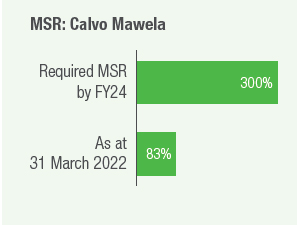
| Element | FY22 (USD'000) |
FY21 (USD'000) |
| Base salary | 663 | 646 |
| Pension | 80 | 78 |
| Benefits(1) | 255 | 181 |
| Short and medium-term incentive(2) | 566 | 993 |
| LTI - PSU/RSU(3) | 1 015 | 534 |
| LTI - SAR(4) | – | 197 |
| Total single figure | 2 578 | 2 628 |
| (1) | Benefits exclude pension and include all benefits not included in base salary such as medical benefits, fringe benefits, family benefits, travel, long-service and disability benefits. The increase in FY22 is mainly due to the annual housing lease increase in Dubai, a 15-year long-service award received and increased travel as COVID restrictions were lifted. |
| (2) | The STI reflects the bonus paid based on the performance of the relevant financial year. During 2017 the MCSA Remco approved a medium-term incentive scheme. The scheme was designed to incentivise the delivery of key business results in FY18 and FY19, with payments taking place in FY20 and FY21 with no more payments to take place under this legacy scheme. |
| (3) | The LTI RSU and PSU values reflected are for the June 2019 and June 2020 awards with performance period ending in FY22 (FY21: June 2019 awards). Calvo's RSU and PSU awards were converted to USD using the year-end (March 2022) exchange rate. |
| (4) | The LTI - SAR reflects the value of SARs that were exercised in FY21 and converted to USD using the November 2020 exchange rate. The SAR scheme was closed in FY21. |
| Salary increase and STI award: | A | B | C | D | E = C x D | F = A x B x E | G = F/A | ||
| Executive director | FY22 salary as at 31 March 2022 ('000) |
FY23 salary ('000) |
FY23 increase (%) |
On-target bonus (%) |
Group/financial goals achieved outcome (%) |
Personal goals achieved outcome (%) |
Total outcome (%) |
FY22 bonus ('000) |
FY22 bonus as % of salary |
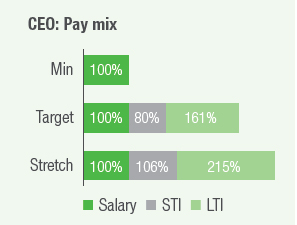
| C P Mawela (US$) | 665 | 685 | 3 | 80 | 110 | 97 | 106 | 566 | 85 |
| LTI shareholding: | |||||||
Share Plan |
Offer date |
Number of shares |
Offer price (ZAR) |
Release date |
Share/unit price as at 31 March 2022 (ZAR) |
Value of awards settled during the financial year ending 31 March 2022 (ZAR) |
Intrinsic value per award of unvested awards as at 31 March 2022 (ZAR) |
| MultiChoice Group RSU and PSU(1) | 18 Jun 2019 | 61 162 | 0.00 | 18 Jun 2021 | – | 7 408 553 | |
| 18 Jun 2019 | 61 162 | 0.00 | 18 Jun 2022 | 131.73 | 8 056 870 | ||
| 18 Jun 2019 | 61 162 | 0.00 | 18 Jun 2023 | 131.73 | 8 056 870 | ||
| 18 Jun 2019 | 61 162 | 0.00 | 18 Jun 2024 | 131.73 | 8 056 870 | ||
| MultiChoice Group RSU and PSU(1) | 10 Jun 2020 | 51 147 | 0.00 | 10 Jun 2022 | 131.73 | 6 737 594 | |
| 10 Jun 2020 | 51 147 | 0.00 | 10 Jun 2023 | 131.73 | 6 737 594 | ||
| 10 Jun 2020 | 51 147 | 0.00 | 10 Jun 2024 | 131.73 | 6 737 594 | ||
| 10 Jun 2020 | 51 149 | 0.00 | 10 Jun 2025 | 131.73 | 6 737 858 | ||
| MultiChoice Group RSU and PSU(2) | 17 Nov 2020 | 70 717 | 0.00 | 17 Nov 2023 | 131.73 | 6 940 085 | |
| MultiChoice Group RSU | 17 Nov 2020 | 10 102 | 0.00 | 17 Nov 2024 | 131.73 | 1 330 736 | |
| MultiChoice Group PSU(3) | 31 Mar 2021 | 120 809 | 0.00 | 31 Mar 2024 | 131.73 | 10 503 352 | |
| Phantom Performance Share Plan 2021(4) | 31 Mar 2021 | 42 767 | 0.00 | 31 Mar 2025 | 121.42 | 1 869 397 | |
| 31 Mar 2021 | 42 767 | 0.00 | 31 Mar 2026 | 121.42 | 1 869 397 |
| (1) | 50% of RSUs issued are subject to performance conditions. |
| (2) | 75% of RSUs issued are subject to performance conditions. |
| (3) | 100% of RSUs issued are subject to performance conditions. |
| (4) | 100% of PPSs issued are subject to performance conditions. The calculation of the PPS unit price is detailed here. |

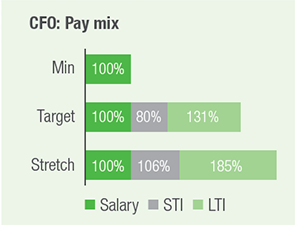
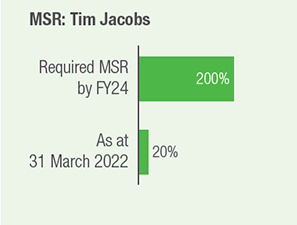
| Element | FY22 (ZAR'000) |
FY21 (ZAR'000) |
| TCTC(1) | 7 447 | 6 241 |
| Pension | 640 | 979 |
| Benefits(2) | 671 | 72 |
| Short and medium-term incentive(3) | 6 294 | 6 825 |
| LTI - PSU/RSU(4) | 4 871 | 2 033 |
| LTI - SAR(5) | – | 14 877 |
| Total single figure | 19 923 | 31 026 |
| (1) | Tim moved to a dual employment contract (ZAR and EUR) during FY22 as he is required to spend a significant amount of time offshore. His EUR portion has been converted to ZAR using the March 2022 exchange rate. |
| (2) | Benefits exclude pension and includes all benefits not included in TCTC such as medical benefits, fringe benefits, family benefits, travel, long-service and disability benefits. The increase in FY22 is mainly due to Tim's benefits for his European contract (which has been converted to ZAR using the March 2022 exchange rate) and increased travel as COVID restrictions were lifted. |
| (3) | The STI reflects the bonus paid based on the performance of the relevant financial year. |
| (4) | The LTI RSU and PSU values reflected are for the June 2019 and June 2020 awards with the performance period ending in FY22 (FY21: June 2019 awards). |
| (5) | The LTI - SAR reflects the value of SARs that were exercised in FY21. The SAR scheme was closed in FY21. |
| Salary increase and STI award: | A | B | C | D | E = C x D | F = A x B x E | G = F/A | ||
| Executive director | FY22 salary as at 31 March 2022 ('000) |
FY23 salary ('000) |
FY23 increase (%) |
On-target bonus (%) |
Group/financial goals achieved outcome (%) |
Personal goals achieved outcome (%) |
Total outcome (%) |
FY22 bonus ('000) |
FY22 bonus as % of salary |
| T N Jacobs (ZAR) | 7 608 | 7 874 | 3.5 | 80 | 110 | 94 | 103.4 | 6 294 | 83 |
| * | Tim's EUR portion has been converted to ZAR using the March 2022 exchange rate. |
| LTI shareholding: | |||||||
Share Plan |
Offer date |
Number of shares | Offer price (ZAR) |
Release date |
Share/unit price as at 31 March 2022 (ZAR) |
Value of awards settled during the financial year ending 31 March 2022 (ZAR) |
Intrinsic value per award of unvested awards as at 31 March 2022 (ZAR) |
| MultiChoice Group RSU and PSU(1) | 18 Jun 2019 | 15 768 | 0.00 | 18 Jun 2021 | – | 1 897 841 | |
| 18 Jun 2019 | 15 768 | 0.00 | 18 Jun 2022 | 131.73 | 2 077 119 | ||
| 18 Jun 2019 | 15 768 | 0.00 | 18 Jun 2023 | 131.73 | 2 077 119 | ||
| 18 Jun 2019 | 15 769 | 0.00 | 18 Jun 2024 | 131.73 | 2 077 250 | ||
| MultiChoice Group RSU and PSU(1) | 10 Jun 2020 | 21 207 | 0.00 | 10 Jun 2022 | 131.73 | 2 793 598 | |
| 10 Jun 2020 | 21 207 | 0.00 | 10 Jun 2023 | 131.73 | 2 793 598 | ||
| 10 Jun 2020 | 21 207 | 0.00 | 10 Jun 2024 | 131.73 | 2 793 598 | ||
| 10 Jun 2020 | 21 207 | 0.00 | 10 Jun 2025 | 131.73 | 2 793 598 | ||
| MultiChoice Group RSU and PSU(2) | 17 Nov 2020 | 52 195 | 0.00 | 17 Nov 2023 | 131.73 | 5 122 357 | |
| MultiChoice Group RSU | 17 Nov 2020 | 7 457 | 0.00 | 17 Nov 2024 | 131.73 | 982 311 | |
| MultiChoice Group PSU(3) | 31 Mar 2021 | 80 732 | 0.00 | 31 Mar 2024 | 131.73 | 7 018 985 | |
| Phantom Performance Share Plan 2021(4) | 31 Mar 2021 | 28 579 | 0.00 | 31 Mar 2025 | 121.42 | 1 249 222 | |
| 31 Mar 2021 | 28 580 | 0.00 | 31 Mar 2026 | 121.42 | 1 249 266 |
| (1) | 50% of RSUs issued are subject to performance conditions. |
| (2) | 75% of RSUs issued are subject to performance conditions. |
| (3) | 100% of RSUs issued are subject to performance conditions. |
| (4) | 100% of PPSs issued are subject to performance conditions. The calculation of the PPS unit price is detailed on here. |
Non-executive directors' fees
The fees paid to non-executive directors by the group are set out below:
| Directors' remuneration | Directors' fees | Committee and trustees' fees and other fees |
Total | ||||
| 2022 Non-executive directors |
Paid for services to the company ZAR |
Paid for services to other group companies ZAR |
Paid for services to the company ZAR |
Paid for services to other group companies ZAR |
Paid for services to the company ZAR |
Paid for services to other group companies ZAR |
ZAR |
| James du Preez (appointed 1 April 2021) | – | – | 745 663 | – | 459 376 | – | 1 205 039 |
| Francis Lehlohonolo Napo Letele (resigned 1 December 2021) | – | – | 557 525 | – | 88 435 | 141 564 | 787 524 |
| Elias Masilela | – | – | 745 663 | – | 344 548 | – | 1 090 210 |
| Kgomotso Moroka | 1 500 000 | – | 745 663 | – | 475 681 | 283 128 | 3 004 471 |
| Louisa Stephens | – | – | 745 663 | 791 945 | 349 425 | 1 887 033 | |
| John James Volkwyn | 5 151 753 | – | – | – | – | – | 5 151 753 |
| Christine Sabwa | – | – | 745 663 | – | 581 102 | – | 1 326 765 |
| Jabulani Mabuza** | – | – | 271 875 | – | 98 750 | – | 370 625 |
| Fatai Sanusi | – | – | 745 663 | – | 118 278 | – | 863 940 |
| Stephan Joseph Zbigniew Pacak (resigned 1 April 2021)* | – | – | – | – | – | – | – |
| 6 651 753 | – | 5 303 375 | – | 2 958 115 | 774 116 | 15 687 360 | |
| * | Resigned on the 1st April 2021 and received no fees. |
| ** | Jabu Mabuza passed away 16 June 2021. |
| Directors' remuneration | Directors' fees | Committee and trustees' fees and other fees |
Total | ||||
| Non-executive directors | Paid for services to the companyUSD |
Paid for services to other group companies USD |
Paid for services to the company USD |
Paid for services to other group companies USD |
Paid for services to the company USD |
Paid for services to other group companies USD |
USD |
| Mohamed Imtiaz Patel - Chair* | 1 124 614 | – | – | – | – | – | 1 124 614 |
| 1 124 614 | – | – | – | – | – | 1 124 614 | |
* Payments relate to the service and restraint agreement entered into between the group and Imtiaz.
Termination payments
No termination payments were made to executive and non-executive directors on termination of employment or office in FY21.
Contractual arrangements
Adv Kgomotso Moroka
The consultancy agreement entered into between the group and Kgomotso for professional advisory services to the group and its subsidiaries. Kgomotso is a Senior Counsel and seasoned legal professional. Given the sensitive nature of some matters and Adv Moroka's understanding of our business and the political, social and legal landscape, she is often consulted to formulate an approach and strategy. For this service we need to compensate her outside of her normal board fees, hence the need for a separate consulting agreement. is considered immaterial to the wealth of Kgomotso and the board has, after consideration on a balanced and substance-over-form basis, determined that the agreement does not affect her categorisation as an independent non-executive director. The consultancy services agreement was renewed for 12 months effective April 2021.
Jim Volkwyn
The consultancy agreement, entered into between the group and Jim for professional advisory services to the group CEO. During FY22 the scope of Jim's consultancy services was reviewed and expanded to cover more strategic advisory services. The services are global in nature and involve key global strategies. The consultancy agreement is complimentary to his director role, involves an annual fee for Jim's additional time and effort to provide global strategic input at an early stage. The group believes that the benefit of leveraging his local and international industry insights and skills is superior to paying external consultants with limited insight into our operations and provides us with a significant strategic advantage as we evaluate many opportunities to grow our business over the longer term. The contract is considered immaterial to Jim's wealth. The board has, after external legal advice and consideration on a balanced and substance-over-form basis, determined that the agreement does not affect his categorisation as an independent non-executive director. Jim has waived any entitlement to director and committee fees paid to non-executive directors.
Imtiaz Patel
The service and restraint agreement entered into between the group and Imtiaz is for the provision of various strategic and advisory support services to the group at a global level. The essence of the agreement is a restraint of trade to ensure that Imtiaz's valuable and sought-after knowledge, experience, contacts and company/global industry insights are retained within the group as he is fundamental in pivoting the group's strategic re-positioning and platform expansion plans. Imtiaz has waived any entitlement to director and committee fees paid to non-executive directors.
Compliance
There were no deviations from the remuneration policy in FY22.
Directors' interest in the MultiChoice Group shares
The directors of the MultiChoice Group (and their associates) had the following beneficial interest in the MultiChoice Group ordinary shares at 31 March 2022:
| MultiChoice Group ordinary shares | Direct | Indirect | Total |
| MI Patel | 27 186 | – | 27 186 |
| C Mawela | 61 162 | – | 61 162 |
| TN Jacobs | 11 338 | – | 11 338 |
| FLN Letele | 88 836 | – | 88 836 |
| JJ Volkwyn | 5 000 | – | 5 000 |
| Total | 193 522 | – | 193 522 |
Non-binding advisory vote on implementation report
The implementation report, as set out in Part 3, will be subject to a non-binding advisory vote by shareholders at the AGM on 25 August 2022.